
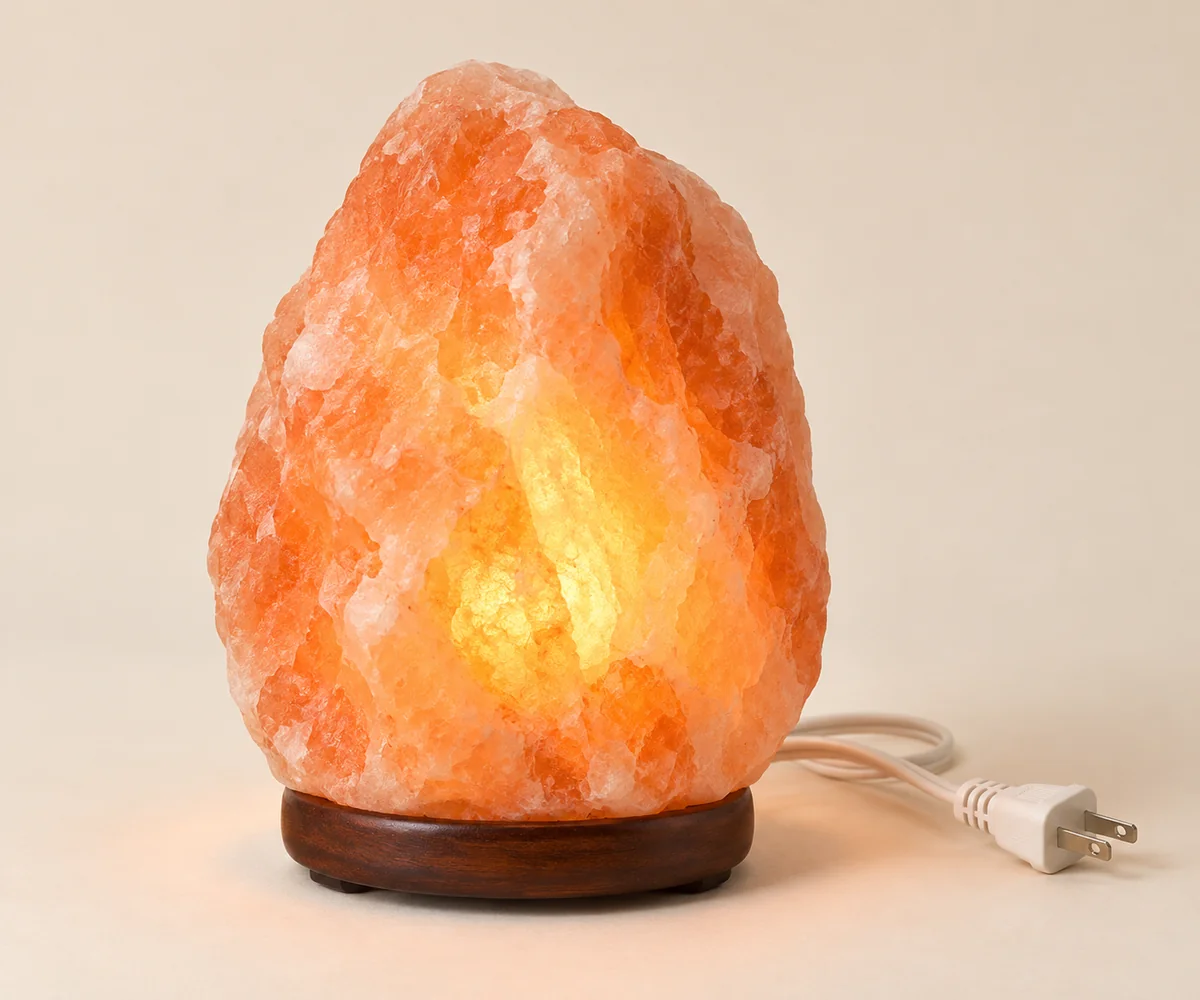
I asked what “ambient field neutrality and airborne energetic equilibrium” meant. Management pointed at the Himalayan Salt Field Lamp. I pointed at the power cord. We spent the rest of the meeting pointing. The lamp costs $189, which includes the mineral's extensive geological experience and our decision to mention it on the invoice.
I distrust official narratives. I also distrust a company that answers a measurement question by changing the adjective before “energy.” A suppressed discovery should have a discovery in it.
01 / A HIGHLY CONFIDENT LIGHT BULB
Inside the field generator: the lamp.
The cutaway below is a conceptual reconstruction of our simple catalog design, not a physical teardown or a laboratory test. It contains a pink salt body, a hollow cavity, an ordinary bulb and socket, a wooden base, a cord and a switch. The electrical job is to power the bulb. The visible job is to make the rock glow. Nothing in that reconstruction supplies a filter, blower, particle collector, high-voltage ion emitter or specified field-control system.
The classified inner lamp
 OPEN FULL-SIZE PHOTOGRAPH ↗
There is no secret compartment in this drawing labelled “physics.” Marketing asked me to add one. Finance asked whether it could renew annually.
02 / IONS HAVE ADDRESSES
An ion inside a rock is not an air-cleaning fleet.
Sodium chloride already consists of positively charged sodium ions and negatively charged chloride ions arranged in a crystal. Water can pull ions from that lattice and surround them in solution. That is why salt dissolves.[1] It does not follow that the lamp broadcasts a useful concentration of negative air ions across a room. Charged chloride in a damp film on a rock and a charged molecule or cluster suspended in air are different situations.
Three meanings of “ions”
 OPEN FULL-SIZE BENCH SKETCH ↗
“Contains negative ions” is therefore an impressively incomplete sales pitch. My kitchen salt contains them. So does the salt management puts around the bunker entrance to discourage auditors with alleged amphibian ancestry. Neither observation supplies an airborne output rate.
03 / WARM IS NOT A PLASMA
The energy scale does not respect the brochure.
For scale, suppose the surrounding air were at 320 kelvin, about 47°C. That is an illustrative temperature, not a measured lamp temperature. With the NIST Boltzmann constant, its characteristic thermal energy, kBT, is about 0.028 electronvolts.[2] NIST lists approximately 15.58 electronvolts to remove an electron from a nitrogen molecule.[3] Those scales differ by roughly a factor of 565.
This comparison illustrates why modestly warming air does not turn it into a useful thermal ionizer. It is not a complete model of every ion-production mechanism. Removing an electron makes a positive ion; negative-ion formation is a different process. The arithmetic does not establish an exact emission rate of zero. It does establish that “the bulb is warm” is a terrible substitute for identifying the mechanism and measuring its output.
Management called the energy shortfall “a proprietary low-energy architecture.” I called it a reading light.
04 / THE ROCK MAY GET DAMP
A wet surface does not drain a room.
Salt can take up moisture under suitable conditions. Pure sodium chloride has an equilibrium humidity near 75% around room temperature in NIST's saturated-solution data.[4] An impure pink rock, its temperature and its surroundings can behave differently. That number is a chemistry reference, not a specification for every lamp.
A moist salt surface still lacks a demonstrated room-scale water-removal rate. If absorbed water is subsequently evaporated by warming, it returns to the room. Without collecting and removing water, or moving it elsewhere, “the lamp dries itself” is not “the room has been dehumidified.”
Dust might land on a damp surface. Dust also lands on the filing cabinet containing our air-cleaning evidence. I refuse to award either object a clean-air performance rating for sitting still and becoming dirty.
05 / WHERE DOES THE DIRTY AIR GO?
Demand a pathway, a collector and a rate.
A powered filter can move air through material that captures particles. Clean air delivery rate, or CADR, is a particle-removal metric used to size air cleaners for a room. Gas removal requires suitable media, such as a sufficiently substantial activated-carbon filter, and particle CADR does not establish gas removal.[5] Our reconstructed rock has no fan-and-filter pathway and no measured CADR. Natural convection around a warm object is movement; it does not specify useful contaminant capture.
Air cleaning needs a removal path
 OPEN FULL-SIZE BENCH SKETCH ↗
Real ion generators charge particles so that they can collect on surfaces or a collector. They are not universal gas-and-odor erasers, and particles deposited on room surfaces can be disturbed again. Some electronic ionizing air cleaners also produce ozone.[6] That warning concerns actual ionizing hardware. It is not evidence that an ordinary salt lamp produces ozone. We cannot borrow another machine's mechanism, performance or byproducts just because the brochure uses the same noun.
06 / AN ATTRACTIVE OBJECT CAN REMAIN AN ATTRACTIVE OBJECT
The glow is the defensible feature.
Enjoy the warm-looking light if you like it. That does not require a theory about neutralizing invisible hostility. There is no established purification performance supplied for this catalog lamp, and I have not tested a real unit. Do not turn that into a claim that every salt surface captures exactly zero particles or that every conceivable commercial lamp emits exactly zero ions. The advertised room-scale effect needs relevant evidence, not an argument about whether one speck could stick.
I would ask for identified contaminants, controlled on-and-off comparisons, background conditions, calibrated instruments and results that separate the lamp from ordinary settling. Ion counts alone would still not demonstrate air cleaning. A subscription receipt would demonstrate that the accounts department remains functional.
Management's improved model is the $14,900 Himalayan Atmospheric Sovereignty Cabinet. It places the same lamp on top of an appropriately sized, independently specified particle filter, then charges $299 a month to explain why the fan is suddenly doing all the work. The lamp remains a lamp. The filter needs replacement because it captures dirt. The royalty courier needs payment because he captures cash.
07 / DOCUMENTS THAT DID NOT COME FROM A GLOWING ROCK
Read the mechanism before buying the mythology.
References checked October 12, 2026. The lamp internals and airflow drawings are conceptual explanations of the catalog design. They are not physical test results. The energy comparison and moisture-accounting conclusions are engineering analysis, with the stated assumptions.
- American Chemical Society, Why Does Water Dissolve Salt?: charged ions in sodium chloride and their separation into water.
- NIST, 2022 CODATA fundamental constants: Boltzmann constant in eV/K.
- NIST Chemistry WebBook, nitrogen ion energetics: evaluated molecular ionization energy.
- Lewis Greenspan, Humidity Fixed Points of Binary Saturated Aqueous Solutions, Journal of Research of the National Bureau of Standards, 1977: equilibrium humidity data for saturated sodium chloride solutions.
- EPA, Guide to Air Cleaners in the Home: particle CADR, filtration and gas-removal media.
- EPA, What Are Ionizers and Other Ozone-Generating Air Cleaners?: particle charging, collection limits and ozone from some electronic air cleaners.
E. Rook / Basement 4. The rock is geologically verified. The claims are awaiting a less inconvenient department.